Clínica Dental Padrós
Articles ·
Do dental veneers damage your teeth? Risks and reality
Do dental veneers damage your teeth?
Under the right conditions, veneers should not damage the teeth. They are very thin restorations bonded to the tooth surface to change the colour, shape, size, apparent position and proportions of the smile, small chips or wear, and some gaps between teeth. In some cases they can be placed with minimal preparation or even without any tooth reduction. The key is for the treatment to be additive or minimally invasive whenever the case allows. The available scientific evidence shows that porcelain veneers can have high long-term clinical survival: a recent systematic review and meta-analysis found survival rates above 93 % at 10 years for different types of ceramic, although the results depend on the material, the clinical case and the technique used. So saying that “getting veneers damages your teeth” is an oversimplification. The right question would be: how were the teeth prepared, how much tissue was preserved and why was that treatment indicated?Do teeth have to be drilled to place veneers?
Not always. Depending on the position, shape, size, colour and volume of the teeth, a veneer may need no preparation, minimal preparation or somewhat more preparation in specific cases. When teeth are prepared, one of the key goals is to keep as much healthy enamel as possible. The scientific literature indicates that porcelain veneers perform better when they can be bonded mainly to enamel, compared with situations where more dentine is exposed. The better the case is planned, the greater the chance of a conservative treatment.When can no-prep veneers be placed?
They can be particularly useful when the teeth are small, there is some space between the teeth, there is mild wear, the tooth position is favourable or the colour can be corrected without a thick layer of material. But there is one essential condition: adding material must not produce overly bulky teeth.When may it be necessary to prepare the teeth?
There are situations where a no-prep veneer may not be the best solution: teeth that are too prominent, major colour changes, major shape changes, unfavourable tooth positions or advanced tooth wear that requires more complex restorative planning.Can veneers cause tooth sensitivity?
Sensitivity depends mainly on the preparation carried out and the condition of the tooth beforehand. If persistent sensitivity appears after veneers are placed, the cause must be investigated: tooth preparation, exposed dentine, pulp inflammation, bite problems, leakage or bruxism. Persistent pain should not be considered normal simply because someone has veneers.Can veneers cause tooth decay?
A properly placed veneer does not make the tooth immune to decay. The tooth still has susceptible areas, especially at the margins of the restoration. That is why good oral hygiene, regular check-ups and a good fit of the restoration are essential. Secondary decay is a possible complication, although the rates reported in clinical studies are low.What happens if veneers are placed on poorly prepared teeth?
A veneer can be an excellent restoration, but it cannot make up for poor planning. If there is active decay, gum disease, poor hygiene, uncontrolled bruxism or significant bite problems, these must be solved first. Placing veneers on top of an unstable dental situation can increase the risk of complications.Can veneers break?
Yes. Although modern porcelain veneers have good strength and clinical survival, no dental restoration is indestructible. The most common complications include fractures, debonding, marginal defects and bite-related problems. A systematic review found an estimated 93 % survival at 10 years, with fracture and debonding among the main complications reported.And if I have bruxism?
Bruxism does not automatically mean you cannot have veneers, but it is a factor that must be taken into account. It may be necessary to diagnose the type of bruxism, analyse the bite, design the restorations properly, consider night-time protection and have regular check-ups.Is composite or porcelain safer?
There is no universal answer. Composite allows very conservative treatments, in some cases without any preparation, and can be repaired directly, although it may change colour or wear over time. Porcelain offers excellent aesthetic stability, high strength and high clinical survival when proper preparation and bonding conditions are maintained.Are veneers for life?
No dental restoration should be presented as permanent. Its survival depends on the material, the technique, the bond, how much enamel is preserved, the bite, hygiene, bruxism, habits and maintenance. Long-term studies show high survival rates at 10 years, but this does not mean every patient will get exactly the same result.So what can really damage the teeth?
More than veneers themselves, there are certain ways of doing aesthetic dentistry that can increase the risks unnecessarily: removing more tooth than necessary, placing veneers when they are not indicated, not studying the bite, not making a complete diagnosis or looking only for a low price. In aesthetic dentistry, planning is part of the treatment.How can I tell whether my case can be treated conservatively?
The best way is an individual diagnosis, which may include facial and dental photographs, smile proportions, gums, tooth position, bite, wear, colour, intraoral scanning, digital models and aesthetic simulations. At Clínica Padrós the aesthetic study can use photography, intraoral scanning, digital models and smile planning to assess which treatment can achieve the desired result while preserving as much tooth tissue as possible.What if I don't really need veneers?
If the problem is mainly the position of the teeth, orthodontics may be more appropriate. If the problem is colour, whitening may be enough. If there is a small loss of structure, an additive composite restoration may be sufficient. Veneers should not be the treatment offered to everyone, but the one indicated when they genuinely offer an advantage.Frequently asked questions about whether veneers damage your teeth
Does getting dental veneers weaken the teeth?Not necessarily. Conservative preparation and proper bonding can preserve a large amount of tooth structure. The prognosis depends on each case.
Are no-prep veneers safer?Not automatically. They are an excellent option when indicated, but adding material without preparing the teeth can produce an overly bulky result in some patients.
Can veneers cause tooth decay?Veneers do not necessarily cause decay, but the tooth remains susceptible to it. Hygiene, the margins and check-ups are essential.
Are porcelain veneers strong?Yes. Clinical studies show high medium- and long-term survival of porcelain veneers, although fractures or debonding can occur.
Can I get veneers if I have bruxism?In many cases yes, but function, the bite and the forces the restorations will have to bear must be studied first.
Do veneers last a lifetime?This cannot be guaranteed. Porcelain veneers can have high survival at 10 years, but the individual result depends on many factors.
Conclusion: do veneers damage your teeth?
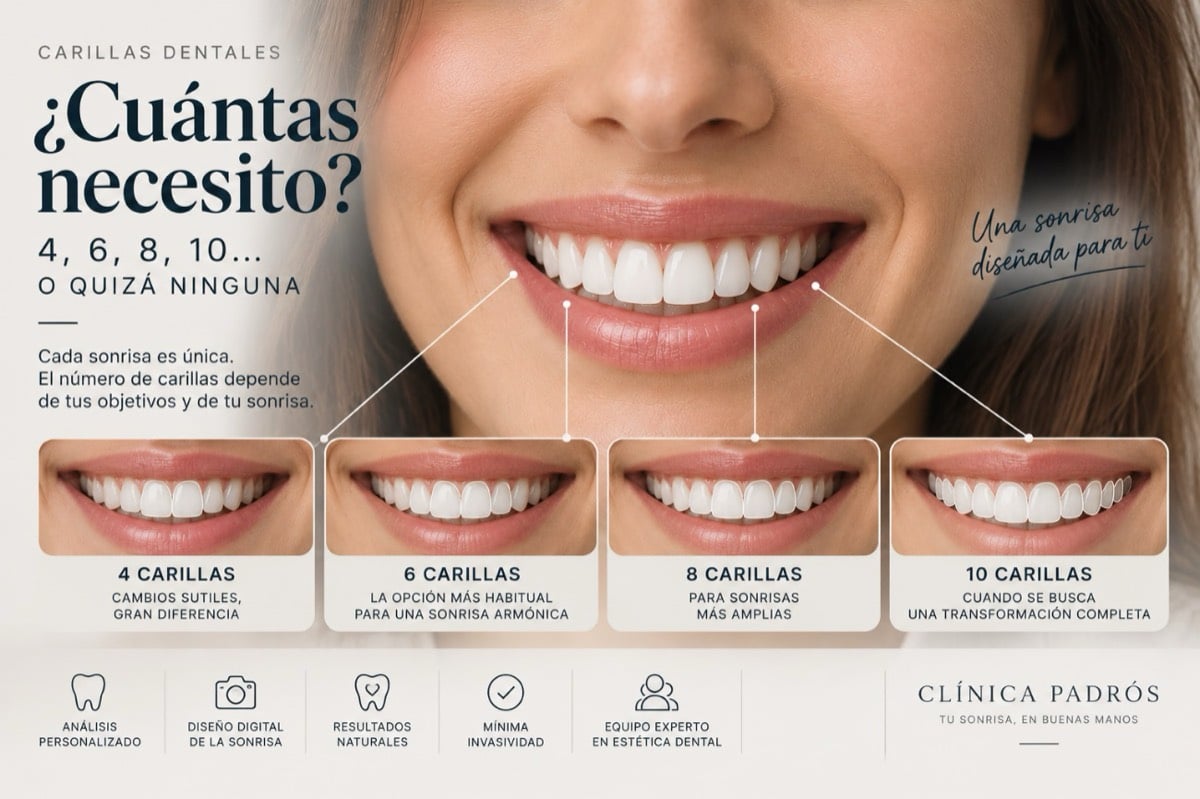
Dental veneers do not have to damage your teeth. The problem arises when treatments are carried out without a proper indication, more structure is removed than necessary, or factors such as the bite, bruxism, gum health or the prior condition of the teeth are not taken into account. Quality aesthetic dentistry should pursue three goals: aesthetics, function and preservation of tissue. So before deciding how many veneers you need, there is a much more important question: what is the most conservative way to achieve the result I want?Would you like to know whether veneers can be placed conservatively in your case?
At a first assessment we can analyse the health of your teeth and gums, your bite, the proportions of your smile and the treatment options before deciding whether veneers really are the best option.Selected references
- A prospective comparative analysis of the survival rates of conventional vs no-prep/minimally invasive veneers over a mean period of 9 years — Smielak B, et al. Clin Oral Investig. 2022.
- Clinical Outcomes of No-prep Veneers and Conventional Veneers: A Systematic Review — Hameed FF, et al. J Contemp Dent Pract. 2025.
- Retrospective clinical evaluation of a no-prep porcelain veneer protocol — De Angelis F, et al. J Prosthet Dent. 2023.
- Esthetic Rehabilitation of the Smile with No-Prep Porcelain Laminates and Partial Veneers — Farias-Neto A, et al. Case Rep Dent. 2015.