Clínica Dental Padrós
Articles ·
Composite or porcelain veneers: which are better?
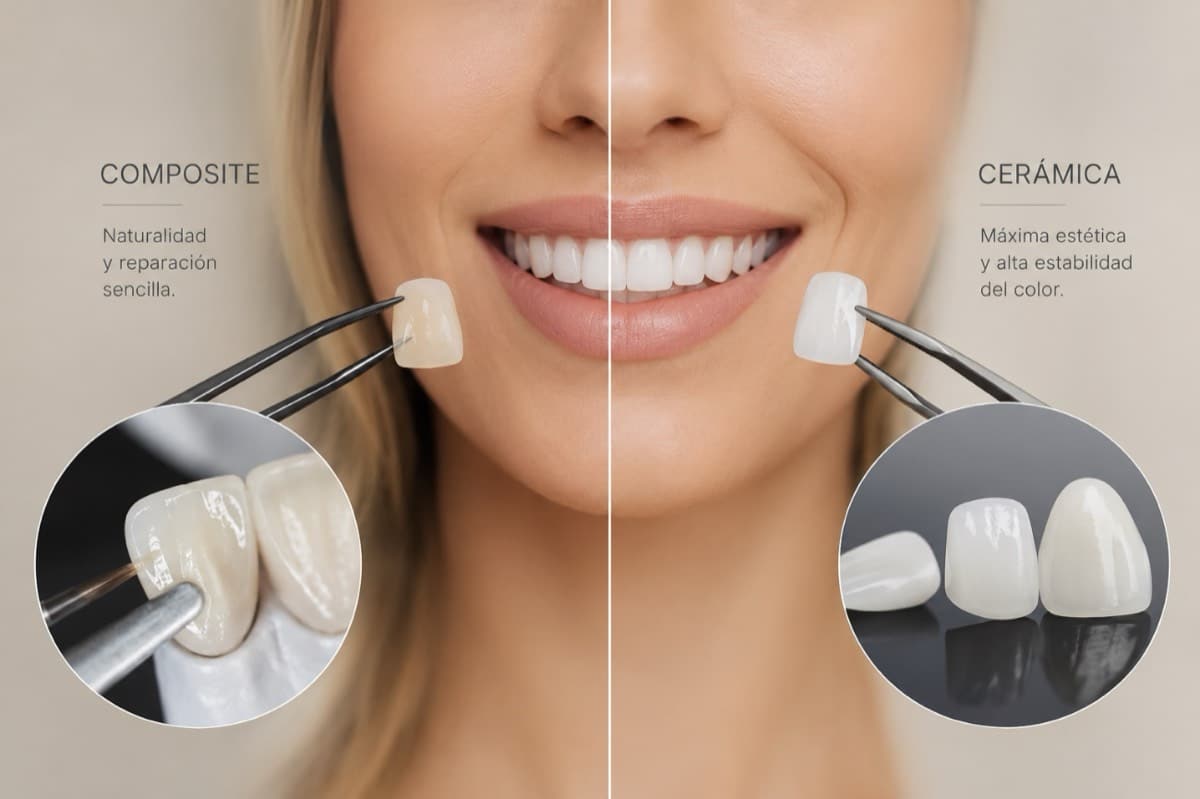
Composite and porcelain veneers: the main differences
| Feature | Composite veneers | Porcelain veneers |
|---|---|---|
| Material | Composite resin | Dental porcelain |
| Fabrication | Directly on the tooth | Indirect (2 visits) |
| Aesthetics | Can give a very natural result | Excellent aesthetics and optical properties |
| Repair | Usually simple | May require replacement or a specific repair |
| Longevity | Depends on the case and maintenance (5–10 years) | High longevity when well indicated (10–30 years) |
| Tooth preparation | Can be very conservative (0.3 mm) | Depends on the design (0.3–0.6 mm) |
| Later changes | Relatively easy | More limited once made |
| Cost | Usually lower | Usually higher |
What are composite veneers?
Composite veneers use a composite resin that is applied and sculpted on the tooth. The dentist can use the material to change certain features of the tooth, such as its shape, length, width or proportion. One of their main characteristics is that they are made directly on the tooth, allowing very controlled changes.What are the advantages of composite veneers?
- A very conservative treatment in certain cases.
- The shape and colour of the teeth can be changed directly, in a single visit.
- Relatively simple repair if a small chip or deterioration occurs.
- Changes or touch-ups are possible.
- Lower initial cost in many cases.
What are porcelain veneers?
Porcelain veneers are restorations made specifically for each patient. Their design takes into account the shape and position of the teeth, the proportions of the smile and other aesthetic and functional factors. Once made, they are bonded to the tooth using a specific protocol.What advantages can porcelain veneers offer?
- Excellent aesthetic results.
- Optical properties similar to those of natural tooth tissue.
- High colour stability.
- Good strength when properly indicated.
- Customised shape, size, texture and colour.
Which looks more natural: composite or porcelain?
Both options can produce natural results. How natural a smile looks does not depend only on the material. The shape of the teeth, proportions, surface texture, colour, translucency, opalescence, fluorescence, the relationship between teeth and gums, tooth position, the smile line and treatment planning all play a part. That is why a good composite veneer can look more natural than a poorly designed porcelain veneer. And a well-planned porcelain veneer can blend in extraordinarily well.Which veneers last longer: composite or porcelain?
In general, porcelain veneers are highly stable and strong when used in properly selected patients and well maintained. Composite veneers can also last a long time, but they may be more prone to surface wear, loss of gloss or staining over time. Longevity depends on factors such as the material, the technique, the quality of the bond, the bite, the patient's habits, bruxism, oral hygiene, maintenance, regular check-ups and the number of teeth treated.Which veneers stain more?
Porcelain has high colour stability. Composite is more prone to surface colour changes or loss of gloss, especially with habits such as frequent coffee, tea or tobacco. Good hygiene and professional check-ups help maintain the result.Which veneers are stronger?
Strength does not depend only on the material. It also depends on the thickness of the restoration, the amount of tooth structure available, the design, the bond, the bite and the forces on each tooth. In patients with bruxism it is important to identify and control excessive forces before carrying out aesthetic rehabilitation.Which veneers are more conservative?
How conservative a treatment is depends on the case and the treatment design, not just the material. In some situations composite allows teeth to be changed very conservatively. There are also cases where porcelain treatments can be done with minimal preparation.Can composite veneers be repaired?
Yes. One of the useful features of composite is that certain chips, wear or small defects can be repaired or modified directly.Can porcelain veneers be repaired?
In some situations this may also be possible, depending on the material, the location and the type of fracture. However, some damage may require removing and replacing the restoration.Which option is cheaper: composite or porcelain?
In general, composite veneers have a lower initial cost than porcelain veneers. But comparing only the price per tooth can be misleading: the cost depends on the number of teeth, the material, complexity, planning, prior treatments, laboratory work and later maintenance.When to choose composite veneers?
They can be particularly useful when small or moderate changes are wanted, a very conservative treatment is preferred, you want the material to be easy to repair or modify, or you are looking for a generally lower initial investment.When to choose porcelain veneers?
They can be particularly useful when a broader aesthetic transformation is wanted, high colour stability is needed, or you want a restorative solution with good long-term stability.What if my teeth are worn?
You should not start by choosing a material. First we need to find out why the teeth have worn down: bruxism, bite problems, habits, erosion, abrasion or a combination of factors. Once the cause has been identified, we can decide which type of restoration is most suitable.And if I have bruxism?
Bruxism is an important factor when planning any restorative treatment. Before placing veneers it is important to assess signs of wear, bite force and pattern, night-time habits and existing restorations. Some patients will need measures to protect the restorations.Composite or porcelain to close gaps between teeth?
It depends on the size and cause of the gap. When there is a small diastema, composite can close the gap conservatively. But in some cases it may be better to use orthodontics to change the position of the teeth.Composite or porcelain for black triangles?
In some cases composite can be used to carefully change the shape of the teeth and visually reduce these spaces. The choice depends on the tooth anatomy, the position of the teeth and the condition of the gums.Which is better for you: composite or porcelain?
Composite can be particularly suitable if you are looking for: a conservative treatment, small or moderate changes, easy repair and a generally lower initial investment. Porcelain can be particularly suitable if you are looking for: a broader aesthetic transformation, high colour stability, excellent optical properties and a very stable result. But there is a third option: neither. If the main problem is the position of the teeth, orthodontics may be more appropriate. If the problem is only colour, whitening may be enough. And if there is significant wear, a more complete rehabilitation may be needed.How do we decide which material to use?
Before recommending composite or porcelain we need to study the smile individually: the condition of the teeth, gum health, bite, wear, position, colour, proportions, smile line, the patient's expectations and treatment alternatives. When indicated, Digital Smile Design can help us analyse proportions and visualise the result before the final treatment.Which do we recommend at Clínica Padrós?
At Clínica Padrós we do not start from the idea that composite is better than porcelain, or the other way round. We start from the diagnosis. Our aim is to determine which option achieves the desired result while preserving as much tooth structure as possible and taking into account function, oral health and the features of each smile.Frequently asked questions
Which is better, composite or porcelain veneers?Neither is universally better. Composite can be very suitable for conservative, repairable changes, while porcelain offers excellent aesthetic properties and colour stability. The choice depends on the case.
Which lasts longer, composite or porcelain?In general, porcelain has high longevity when properly indicated and maintained. Composite can also last many years, although it may need maintenance or touch-ups more often.
Which veneers look more natural?Both can look natural. Shape, proportions, colour, texture, translucency and planning matter as much as the material.
Which veneers stain less?Porcelain has high colour stability. Composite may show more surface changes over time.
Which veneers are cheaper?Composite usually has a lower initial cost than porcelain, although the final price depends on the complexity of each treatment.
Can composite veneers be repaired?Yes, certain chips or defects can be repaired or modified directly, depending on the type of damage.
Can I get veneers if I have bruxism?It may be possible, but bruxism must be assessed before treatment and controlled when indicated.
Do I need veneers, or could my problem be solved another way?Not necessarily. Depending on the problem, whitening, orthodontics, gum treatment or different restorations may be more suitable options.
Conclusion: it's not about choosing the “best” veneer, but the right one
Composite veneers and porcelain veneers can both be excellent tools in aesthetic dentistry. Composite stands out for its versatility, repairability and potential for conservative treatment. Porcelain can offer excellent aesthetic properties, colour stability and strength when properly indicated. But the decision should not start with the material. It should start with a different question: what does my smile really need? At Clínica Padrós we study each case individually to design personalised treatments, aiming for a natural result and preserving the health and structure of the teeth as much as possible.If you'd like to know approximate prices, see our guide on how much dental veneers cost in Barcelona.
Thinking about veneers but not sure which to choose?
Book a first assessment and we will go through the different options with you before deciding on treatment.Selected references
- Anterior Veneer Restorations – An Evidence-based Minimal-Intervention Perspective — Araujo E, Perdigão J. J Adhes Dent. 2021.
- Comparison of conventional ceramic laminate veneers, partial laminate veneers and direct composite resin restorations in fracture strength after aging — Gresnigt MMM, et al.
- Clinical performance of laminate veneers: A review of the literature — Komine F, et al. J Prosthodont Res. 2024.
- Is There Space for Resin Composite Restorations in a World of CAD-CAM and Digital Dentistry? — Dávila-Sánchez A, Fahl N Jr. J Esthet Restor Dent. 2025.