Clínica Dental Padrós
Articles ·
Types of composite veneers: 4 techniques and their differences
What is a composite veneer?
It is an aesthetic restoration made with composite resins that changes the visible surface of the tooth: shape, size, length, proportions, small gaps, certain wear, asymmetries, texture, colour and small defects or chips. One of its great advantages is that it allows very conservative work. In many cases we can add composite directly onto the enamel without preparing the tooth; in others we need to make small changes to create space or help the restoration blend in.The 4 main types of composite veneers
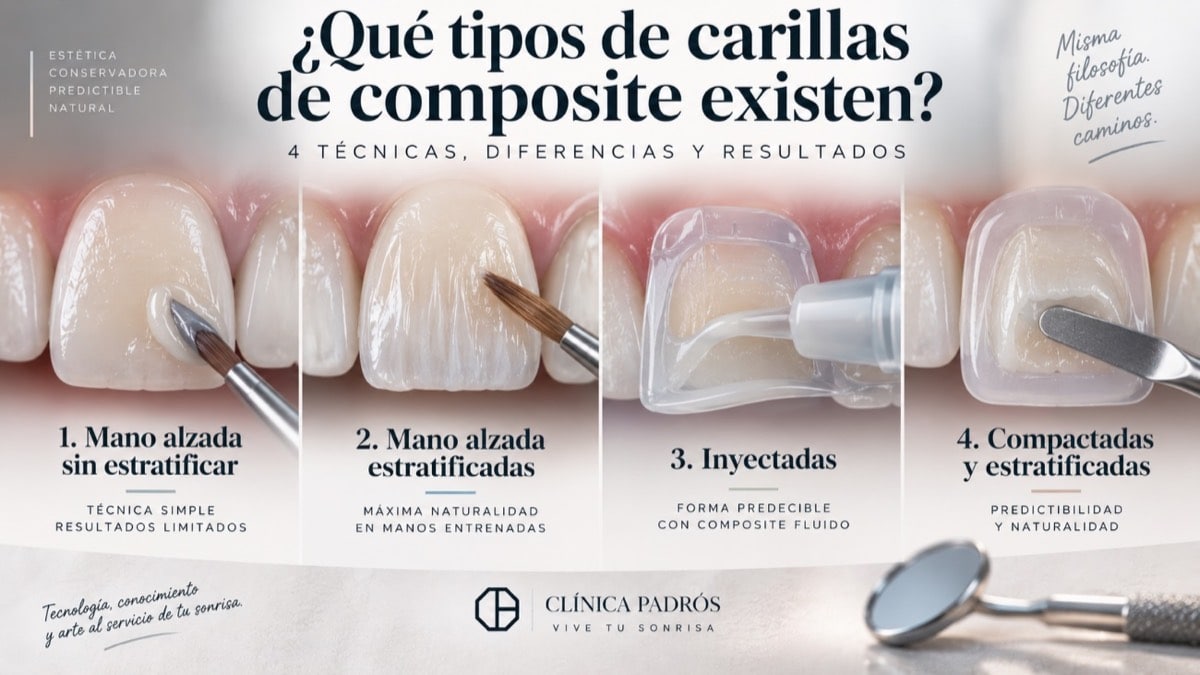
We can divide them into four main groups: freehand veneers without layering, freehand layered veneers, injected veneers, and veneers compacted and layered using an index. All four use composite, but they don't necessarily give the same result.1. Freehand composite veneers without layering
This is conceptually the simplest technique. The dentist places composite directly on the tooth and sculpts the new shape, basically using one shade or a very limited number of composite shades. This allows shape, volume, length and small gaps to be changed quickly, and it can be perfectly suitable for simple restorations. The problem arises when we want to reproduce very faithfully the optical complexity of a natural tooth, which has different colour saturation, translucency, opalescence and internal effects. For a small change it may be enough, but high-level aesthetic transformations generally need much greater control of optics and anatomy.2. Freehand layered composite veneers
Here the restoration is also made directly on the tooth, but using different composite shades and layers to try to reproduce the optical structure of a natural tooth: dentine composites (for opacity and inner body) and enamel composites (for translucency and how light behaves at the surface), plus characterisations and optical effects. In experienced hands a layered veneer can look extraordinarily natural, but the technique depends enormously on the operator: small differences in the thickness of a layer can considerably change how the restoration behaves optically.3. Injected composite veneers
This introduces a very interesting concept: transferring a shape that has been designed beforehand. A typical protocol includes analysis of the patient, digital smile design, a wax-up or 3D design, a mock-up to validate the design in the mouth, printing the 3D model, making a clear silicone index and, after the bonding procedures, injecting flowable composite through the index. Its great advantage is predictability of shape: the anatomy doesn't have to be rebuilt entirely “by eye” during treatment. Its limitation is that, since it mainly injects a single flowable composite shade, it is harder to reproduce individual dentine and enamel shades, complex colour gradients or incisal translucency. High-performance flowable materials are now available, so it is best not to generalise about their mechanical properties.4. Composite veneers compacted and layered using an index
This technique combines the predictability of a pre-designed shape with the optical naturalness of a layered restoration. The process includes: designing the smile first (photographs, scanning and facial analysis), trying the design with a mock-up, transferring the shape with an index and, instead of injecting flowable composite, compacting dense restorative composites with different shades (dentine, enamel, characterisations and incisal effects), layer by layer. Its advantages: the shape has already been designed and tried, high-performance restorative composites can be used, the restoration can be layered and characterised, and the operator keeps artistic control over its optical build-up.The 4 types of composite veneers compared
| Technique | Pre-designed shape | Layering | Potential natural look | Tooth preservation |
|---|---|---|---|---|
| Simple freehand | Not necessarily | Low/none | Variable | Very high |
| Layered freehand | Not necessarily | High | Very high | Very high |
| Injected | Yes | Usually limited | Good, depending on case/material | Very high |
| Compacted + layered | Yes | High | Very high | Very high |
The big difference: copying a shape or copying a tooth
A technique can reproduce the shape of a tooth perfectly. But making it look like a natural tooth also requires control of colour, opacity, translucency, opalescence, texture, characterisations and light reflection. In advanced aesthetic dentistry, shape and colour are not enough: we try to reproduce how the restoration interacts with light.Do composite veneers require drilling the teeth?
One of the great advantages of composite techniques is their conservative potential. In many cases we can work in a completely additive way, especially to increase volume, close gaps, increase length or rebuild wear. In other cases we make small changes to create space or improve integration. Our philosophy can be summed up like this: add whenever we can, modify only when necessary.How do you choose which composite technique to use?
Before deciding, it is worth studying: what we want to change, how much colour change we need, how complex the anatomy is, whether we need to try the result beforehand and what level of characterisation we are looking for.Why is a mock-up so useful?
Because it turns the process from “make the veneers and see if we like them” into “design, try, modify, validate and make”. That increases predictability and has another advantage: the patient takes part in the decision, judging their new smile on their own face, not just on a screen.Which technique gives the most natural-looking composite veneers?
No technique automatically guarantees a natural look. But when we are aiming for the highest aesthetic standards, being able to control dentine, enamel, translucency, opalescence, incisal effects and texture independently gives us extra tools to reproduce a natural tooth. That is why layered techniques, whether freehand or assisted by an index, offer enormous aesthetic potential in trained hands.What should I ask if I'm offered composite veneers?
- How will they be made?
- Will there be a design beforehand?
- Will I be able to try the smile with a mock-up?
- What type of composite will be used?
- Will it be a layered technique?
- Will different dentine and enamel shades be used?
- Will my teeth need to be prepared?
- How will maintenance be carried out?
Frequently asked questions
Are all composite veneers the same?No. They can vary enormously depending on the technique, material, planning, layering, finish and the dentist's experience.
What are layered composite veneers?They are restorations made with different layers and shades of composite to try to reproduce the optical features of a natural tooth, such as dentine, enamel, translucency and incisal effects.
What is injected composite?It is a technique in which a pre-designed anatomy is transferred to the mouth using a clear index and a composite suitable for injection.
What is the difference between injected and compacted composite?In the injection technique the material is introduced through the index in a sufficiently fluid state. In the compaction technique denser restorative composites are adapted by hand inside a guide, allowing greater control of layering.
Can composite veneers be done without drilling?Yes, in many cases, especially when we can add volume. In others minimal preparation may be needed.
Are injected veneers bad?No. It is a very useful technique when properly indicated and it offers great predictability of shape.
What is the advantage of doing a mock-up first?It lets you try out and modify the shape of the future smile before the final restorations are made.
So which is the best technique?
It depends on the patient. But when we are looking for a highly demanding aesthetic transformation, we particularly value three things: preservation (keeping as much of the natural tooth as possible), predictability (being able to design and try the result beforehand) and a natural look (also reproducing the optical complexity of the tooth). That is why combining digital design, a mock-up, transfer of the anatomy and layered composites is particularly interesting.The most important idea
Next time you hear “composite veneers”, remember that the term only tells you the material. It doesn't tell you how they have been designed, how they will be made, whether they will be layered, whether the shape will be tried first or how much tooth tissue will need to be changed. Not all composite veneers are the same, even if they are all called composite veneers.Thinking about composite veneers?
At Clínica Padrós we can first study your smile, analyse what we want to change and decide which technique will achieve the result in the most conservative and predictable way. The aim is not simply to put composite on the teeth. It is to make it stop looking like composite.Selected references
- Injectable Flowable Resin-based Composite Veneers Prior to Ceramic Veneers — Villalobos-Tinoco J, et al. Oper Dent. 2023.
- The injectable composite resin technique: biocopy of a natural tooth – advantages of digital planning — Geštakovski D. Int J Esthet Dent. 2021.
- A direct composite resin stratification technique for restoration of the smile — Pontons-Melo JC, et al. Quintessence Int. 2011.