Clínica Dental Padrós
Articles ·
No-prep veneers: is it really possible?
What are no-prep veneers?
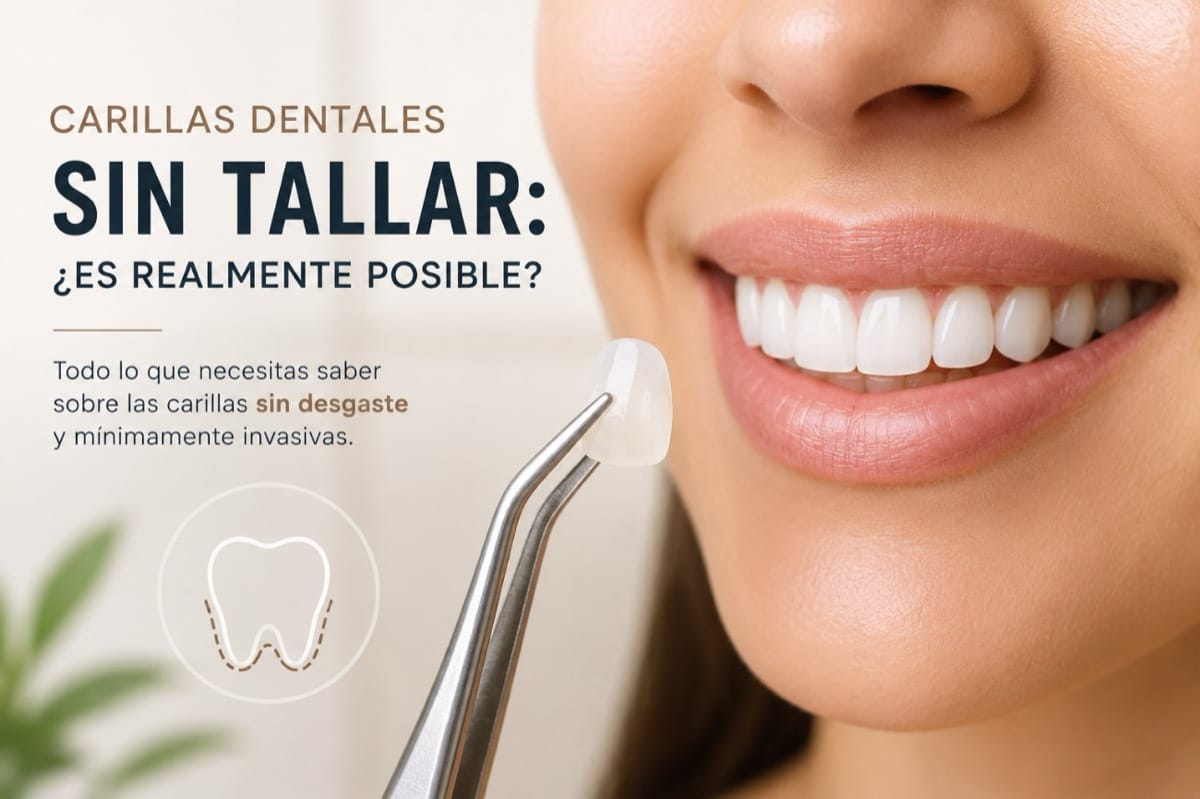
No-prep veneers are restorations placed on the teeth without conventional tooth preparation. In some cases the material can be added directly onto the tooth, as with certain composite techniques. In others, very thin restorations can be designed that require minimal or no preparation in specific situations. The key idea is that not every veneer treatment necessarily needs conventional tooth reduction. But that does not mean any patient can have veneers without changing the teeth.Can veneers be placed without drilling the teeth?
Yes, but it depends on each patient's anatomy
In some cases the shape, proportion or appearance of the teeth can be improved with a very conservative technique and no conventional reduction. This may be possible, for example, when the teeth are relatively small, slightly narrow, short compared with the desired proportion, or can be changed aesthetically without adding too much bulk. But in other cases adding material onto the teeth can make them look too thick, alter the bite or produce an unnatural result. That is why “no-prep” should not be the goal of the treatment in itself. The goal should be to achieve the necessary result using the most conservative technique that is clinically appropriate.What does “no-prep” really mean?
This term can cause some confusion. When people talk about no-prep veneers, they usually mean avoiding conventional tooth preparation. However, there are different clinical situations.No preparation
In some cases material can be added onto the tooth without removing any tooth structure.Minimal preparation
In other cases a very small preparation may be needed to achieve proper aesthetic and functional integration.Conventional preparation
When the position, shape or volume of the teeth requires it, a greater amount of preparation may be needed. So we should not frame treatment as a choice between “no-prep veneers” and “prepared veneers”. The more important question is: how much change to the teeth does my case really need?Which patients may be good candidates for no-prep veneers?
There is no list that can decide this without a clinical assessment, but conditions may be favourable when the patient has healthy teeth and favourable anatomy. For example, these techniques can be considered for small teeth, short teeth, certain shape irregularities, small gaps, some aesthetic irregularities or certain black triangles.When are no-prep veneers NOT indicated?
This point is particularly important. They may not be the best option when the teeth are already bulky, the position of the teeth does not allow material to be added, there is significant crowding, the position of the teeth needs to change considerably, there is a significant bite problem, or the result would produce overly thick teeth. Minimally invasive dentistry does not mean never touching the teeth. It means preserving as much healthy structure as possible without compromising the result.Are no-prep veneers more conservative?
They can be. When a case allows a restoration without removing tooth structure, that preparation is obviously avoided. But tooth conservation should not be measured only by whether the tooth has been prepared. We also need to consider how much material is added, the design of the restoration, the fit, hygiene, the bite, gum health and function.Are no-prep veneers reversible?
It is important not to claim that any treatment without preparation is automatically reversible. If material is added to a tooth without removing structure, the treatment may be more conservative in terms of tooth structure. But a restoration is still a treatment that must be properly designed, placed and maintained.Do no-prep veneers look natural?
Yes, they can look natural when the amount of material, the shape and the proportions are properly designed. But they can also look unnatural if too much bulk is added. A natural smile depends on width, length, proportion, shape, texture, colour, translucency, the relationship between teeth and gums, the smile line and the relationship with the lips and face.Can no-prep veneers make teeth look bigger?
Yes. If the tooth already has the right width and volume, adding material can make it look wider or more prominent. For this reason, no-prep veneers usually make more sense when there is enough anatomical space for the change you want.Can no-prep veneers be placed on crowded teeth?
It depends on the degree of crowding. If the teeth are too close together or out of position, adding material can increase the bulk even further. In these cases it may be better to consider orthodontic treatment first and, once the position of the teeth has been corrected, decide whether small aesthetic changes are needed.Can no-prep veneers be used to close gaps?
In some cases yes, when the gap is small and related to tooth proportions. But if the problem is mainly one of position, orthodontics may be a more suitable alternative.Can they be used to correct black triangles?
In some cases, yes. When the tooth anatomy allows, composite can be used to change the shape of the teeth and reduce these spaces very conservatively.Composite or porcelain for no-prep veneers?
Composite
Material can be added and sculpted directly on the tooth. It can be particularly useful when small changes are needed and a conservative, adjustable technique is wanted.Porcelain
It can be used in some situations when a custom restoration with excellent aesthetic properties and colour stability is wanted. But the fact that a veneer is very thin does not automatically mean it can be placed on any tooth without preparation.No-prep veneers or Invisalign?
It depends on the problem. If the main problem is the position of the teeth, orthodontics may be the most suitable option. For some patients both techniques can be part of the same treatment: first the position of the teeth is corrected with orthodontics and then small aesthetic changes are made.No-prep veneers or whitening?
If the teeth have a suitable shape and position and the main problem is colour, teeth whitening can be a much more conservative alternative. Veneers make sense when we need to change shape, size, proportion or certain colour problems that whitening cannot change.Can no-prep veneers fix worn teeth?
In some cases they can help recover part of the lost anatomy, but first we need to find out why the teeth have worn down. If there is bruxism, it is important to study the forces on the teeth before placing restorations.What advantages can no-prep veneers have?
When properly indicated: preservation of tooth structure, a very minimally invasive treatment, the ability to change the shape of the teeth, easy repair with some techniques and less need for tooth preparation.What are their drawbacks or limitations?
Not every patient is a candidate; they can add bulk to the teeth; on their own they do not solve tooth position problems; they do not replace treatment of tooth or gum disease; and the bite can limit what is possible.How is it decided whether I can have no-prep veneers?
The decision must be based on a diagnosis that studies: dental health, gum health, the position of the teeth, the bite, proportions, the smile and the patient's real goal.Can I see the result before the veneers are placed?
Digital planning can be particularly useful in aesthetic treatments. Using photographs, digital records and design tools, we can study the proportions of the smile and plan the changes. In some cases a trial run can be done to see how the smile changes before going ahead with the final restorations.What should I ask before getting no-prep veneers?
- Am I really a candidate for treatment without preparation?
- Which material will be used?
- How much bulk will be added to my teeth?
- How will it affect my bite?
- Can I see the design beforehand?
- Is there an even more conservative alternative?
- Do I need orthodontics or whitening first?
- What maintenance will I need?
What is the difference between “no-prep” and “minimally invasive”?
No-prep means that no conventional tooth preparation is carried out. Minimally invasive means preserving as much tooth structure as is compatible with a good result. A minimally invasive treatment may involve minimal preparation if it is necessary.What is the goal of a good veneer treatment?
The goal should not be to place no-prep veneers or to get the whitest, biggest or most perfect teeth possible. The goal is a healthy, functional, well-proportioned, natural, personalised smile that is as conservative as possible.Frequently asked questions about no-prep veneers
Is it really possible to get veneers without drilling the teeth?Yes, in some cases. It depends on each patient's anatomy, tooth position, bite and aesthetic goals.
Are no-prep veneers always better?No. They can be more conservative when properly indicated, but they are not suitable for every case.
Are no-prep veneers reversible?This should not be assumed automatically. Reversibility depends on the technique, the material and the bonding procedures.
Can I get no-prep veneers if my teeth are crooked?It depends on how far out of position they are. When there is a position problem, it may be better to correct it first with orthodontics.
Can black triangles be corrected without drilling?Usually yes, with very conservative restorative techniques, depending on the tooth anatomy.
Do I need Invisalign before getting veneers?Not always. But if there is a significant tooth position problem, orthodontics may be a more suitable first step.
Can I get no-prep veneers if I have bruxism?Bruxism must be studied before any restorative treatment to decide whether veneers are appropriate.
Conclusion: are no-prep veneers possible?
Yes, but not for everyone. No-prep veneers can be an excellent option when the patient's anatomy allows the necessary material to be added without excess bulk or compromising function. In other cases minimal preparation may be more suitable, and for some patients the best option will be not to place veneers and to choose orthodontics, whitening or another treatment. At Clínica Padrós we study each smile individually, taking into account dental and gum health, function, proportions and aesthetic goals before recommending a treatment.If you'd like to know approximate prices, see our guide on how much dental veneers cost in Barcelona.
Would you like to know whether your smile can be improved without drilling your teeth?
Book a first assessment and we will go through the different alternatives with you before making a decision.Selected references
- Clinical Outcomes of No-prep Veneers and Conventional Veneers: A Systematic Review — Hameed FF, et al. J Contemp Dent Pract. 2025.
- Clinical survival of No-prep indirect composite laminate veneers: a 7-year prospective case series study — Kam Hepdeniz O, Temel UB. BMC Oral Health. 2023.
- A prospective comparative analysis of the survival rates of conventional vs no-prep/minimally invasive veneers — Smielak B, et al. Clin Oral Investig. 2022.
- Conventional Versus Minimally Invasive Veneers: A Systematic Review — Meer Rownaq Ali AB. Cureus. 2023.