Clínica Dental Padrós
Articles ·
Dental veneers before and after: results and changes
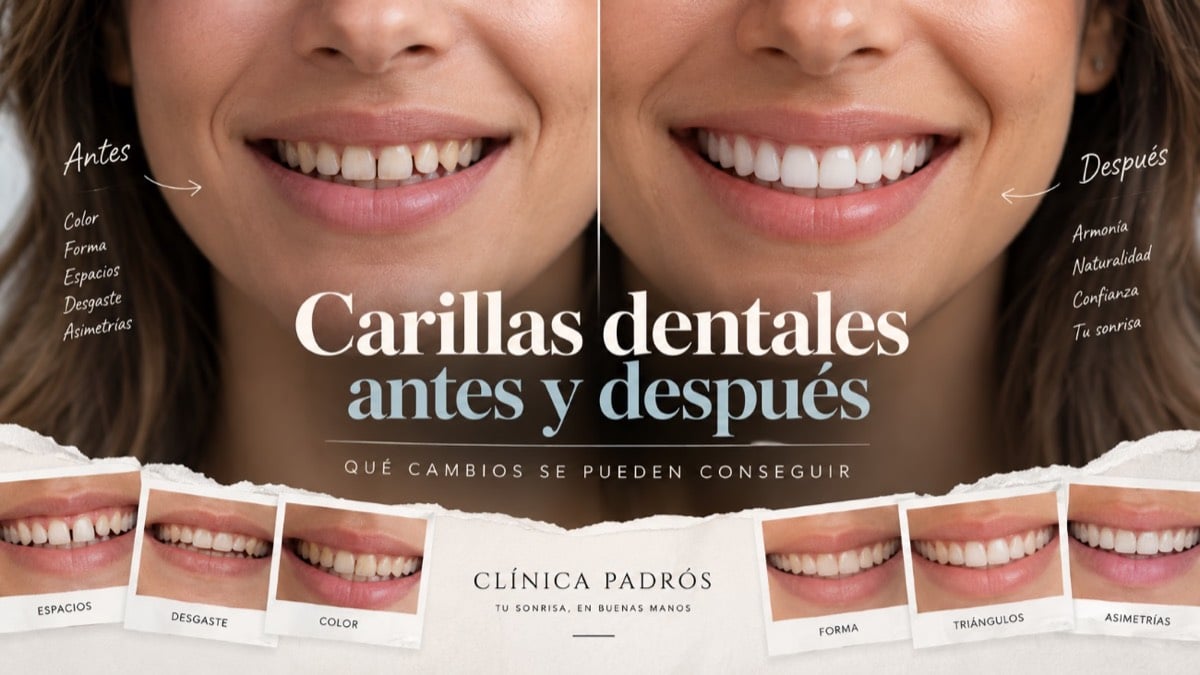
When someone is considering dental veneers, one of the first things they usually do is look for before-and-after photos of veneers. It makes sense: we want to imagine how our own smile could change.
However, looking at before-and-after photos without knowing what lay behind each case can lead to the wrong conclusions. Two patients can have smiles that look similar and need completely different treatments.
That is why, when we look at a before and after, the most interesting question is not only “does it look better?”, but “what was changed to achieve that result, and how much did we have to do to the teeth?”.
What can dental veneers change?
Veneers can change several visible features of the front teeth: shape, size, length, proportions, colour, small gaps between teeth, certain asymmetries, some wear, certain surface defects and, within limits, how the position of the teeth is perceived. But veneers should not be used to solve every aesthetic problem. The real goal is not the biggest possible change, but the right change using the most conservative treatment that can achieve it.1. Changing the shape of the teeth
Some people have perfectly healthy teeth whose shape does not harmonise with their smile: small lateral incisors, overly square teeth, irregular edges or asymmetries. In many of these cases we can change the shape with composite added directly to the tooth or with porcelain veneers, which helps the patient see that aesthetic dentistry is not only about whiter teeth.2. Lengthening worn teeth
Over the years, especially in patients with certain wear patterns or bruxism, the teeth can lose length and the smile can look older. In some cases we can restore the lost length with bonding techniques, but if there is tooth wear it is not enough to rebuild what was lost: we also need to study why it happened, analysing the bite, jaw movements and possible bruxism.3. Closing gaps between teeth
Small gaps or diastemas are another common indication. In some cases we can close them simply by adding material, without removing tooth structure. But a gap shouldn't be closed any old way: if we simply widen the teeth, we can upset their proportions, so we study width, length, position, gums and symmetry together.4. Correcting small teeth
Some people have teeth that are small in proportion to their face, lips or smile, such as peg-shaped lateral incisors. Here additive techniques can let us change the smile considerably while preserving a great deal of tooth structure, making these patients excellent candidates for treatments with very little or even no preparation.5. Improving colour
This is one of the changes that stands out most in before-and-after photos. But not every dark tooth needs a veneer: if the shape, position and structure of the teeth are suitable and the main problem is colour, the first treatment to consider may be teeth whitening. Veneers make more sense when we want to change colour, shape, proportion and texture at the same time.6. Improving certain tooth positions
Veneers can visually correct small position problems, but they don't move teeth. If a tooth is clearly out of position or there is significant crowding, it may be better to have orthodontics first: a better tooth position can mean less preparation and fewer veneers.7. Closing black triangles
So-called black triangles are small dark spaces that appear between the teeth, usually near the gum. Depending on their cause, we can use additive composite techniques to carefully change the profile of the teeth and reduce or close these spaces, in well-selected cases without removing tooth structure.8. Correcting asymmetries
Our brain quickly spots certain differences between the two sides of a smile: a shorter incisor, a smaller lateral, a different angle. But this doesn't mean we should seek absolute mathematical symmetry: natural teeth have small differences, and an overly symmetrical smile can look artificial. The aim is harmony, not identical teeth.9. Changing texture and the way the teeth reflect light
This change is less obvious in general photos, but it is extremely important up close. Natural teeth have macro-texture, micro-texture and different degrees of translucency. When we make advanced aesthetic restorations we try to reproduce these features: that is why two veneers of exactly the same colour can look completely different.10. Making a smile look younger
Teeth change over time: they can wear, darken, lose texture or change their edges. Restoring certain features can make a smile look younger. But looking younger doesn't mean making childlike teeth: age, features, lips, personality and expectations must all be part of the design.How far can veneers correct a smile?
Veneers are extraordinarily versatile, but they don't solve every problem. They don't automatically replace orthodontics when teeth need to be moved, gum treatment when there is a gum problem, whitening when the only problem is colour, or functional rehabilitation when there is complex wear. One of the most important decisions in an aesthetic treatment is knowing when NOT to do veneers.Composite or porcelain: which gives better before-and-afters?
Both materials can produce outstanding results. Composite is applied directly on the teeth with enormous versatility, and can be repaired and modified relatively easily. Porcelain offers excellent optical properties and great stability of surface, colour and gloss. The right question is not “which material is better?”, but “which material is better for this patient, these teeth and this goal?”.Is it possible to make a big change without drilling the teeth?
Yes, in selected cases, when there is room and we want to increase length or volume, close gaps or rebuild wear, we can work mainly additively. But “no-prep” should not become a sales promise for everyone: if there isn't enough room, adding material indiscriminately can produce overly thick teeth.How many veneers does a good before and after take?
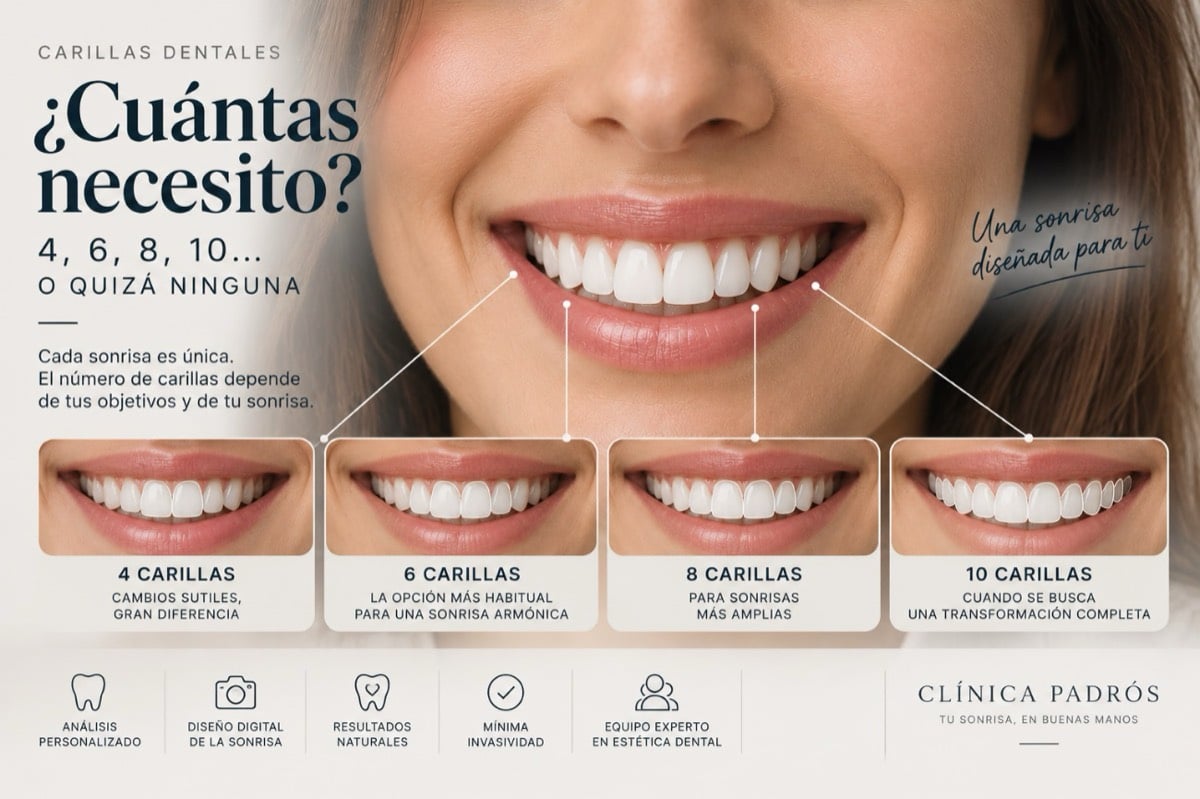
There is no standard number either: one patient may need 1 or 2 to correct very localised problems, 4 if the problem mainly affects the incisors, 6 to include the canines, or 8–10 for wider smiles. And another patient may need no veneers at all. The decision depends on which teeth show when smiling, colour, position, proportions, gums, bite and the final goal.You should be able to try the before and after first
A photo of a finished case is very useful for understanding what is possible, but there is something even more interesting: being able to see your own possible result. That is why we use digital planning tools and, when the case allows, an aesthetic trial or mock-up, so that length, shape, volume, proportions and integration with the lips can be assessed before the final treatment.Before and after: don't just compare the teeth
Don't look only at a close-up of six teeth. Look at the face too: do the teeth fit with the lips? Does the smile seem to belong to that person? Is there facial harmony? Do the gums go with the result? A restoration can be technically spectacular up close and yet not fit properly with the face.How to judge before-and-after photos of veneers
Look for comparable photos (similar position, lighting and magnification), look at close-ups but also at facial photos, look for different types of cases (not just extreme makeovers) and ask what treatment was done: a “veneers before and after” may also include orthodontics, whitening or gum treatment.What result should I expect from good veneers?
There is no universal perfect smile. A good result should be natural, harmonious, conservative, functional, maintainable and, above all, personalised. The best before and after isn't necessarily the one where the teeth have changed the most: very often it is the one where, after treatment, it looks as if the teeth should always have been that way.Frequently asked questions about dental veneers before and after
Do veneers change the smile a lot?They can make very significant changes to shape, proportions, length, colour and harmony. How big the change is depends on the initial problem and the patient's goal.
Can I see how my veneers would look before having them done?In many cases we can use digital design, simulations and aesthetic trials or mock-ups to assess shape, length and proportions beforehand.
Can veneers correct crooked teeth?They can camouflage small position problems, but they don't replace orthodontics when the teeth really need to be moved.
Can gaps be closed without drilling the teeth?In some cases yes. Additive treatments with composite or porcelain can close gaps without removing tooth structure.
Does a spectacular before and after mean the teeth were heavily drilled?Not necessarily. Some very striking changes can be achieved with mainly additive techniques.
The philosophy behind a good before and after
When we show a finished case it is easy to focus only on the final result. But for us there is another, equally important picture: the tooth underneath. Our philosophy can be summed up like this: change everything necessary, preserve everything possible. The real success of veneers shouldn't be measured only by the difference between two photos, but by having achieved a more harmonious, natural and functional smile while preserving the patient's teeth as much as possible.Would you like to know what changes could be made to your smile?
At Clínica Padrós we study each case individually through aesthetic and functional analysis, photography, digital scanning and, when indicated, simulation and an aesthetic trial beforehand. The aim is not to decide how many veneers we can place, but to find the most conservative solution that achieves the smile we are looking for.Selected references
- Digital smile design and mock-up technique for esthetic treatment planning with porcelain laminate veneers — Garcia PP, et al. J Conserv Dent. 2018.
- Enhancing Smile Aesthetics and Function with Lithium Disilicate Veneers: A Brief Review and Case Study — Villalobos-Tinoco J, et al. Clin Pract. 2025.
- Anterior Veneer Restorations – An Evidence-based Minimal-Intervention Perspective — Araujo E, Perdigão J. J Adhes Dent. 2021.