Clínica Dental Padrós
Articles ·
How many dental veneers do I need? 4, 6, 8 or 10?
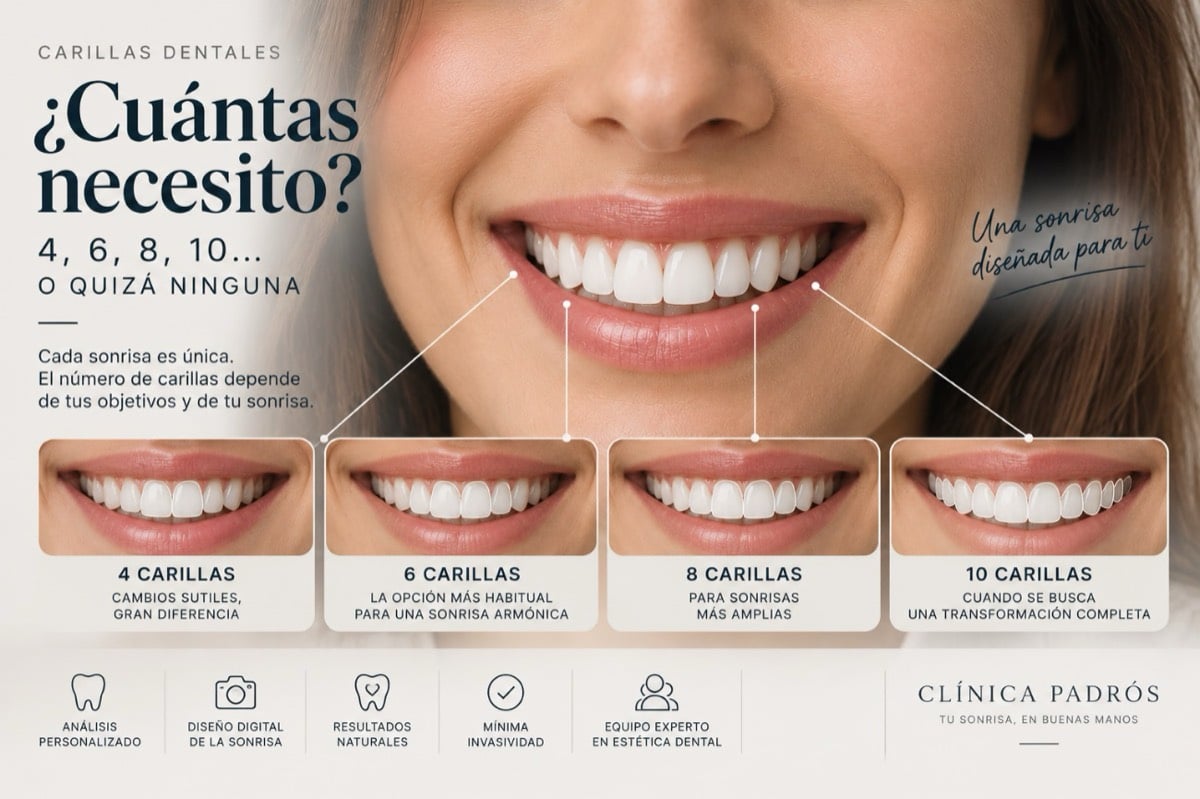
If you are thinking about improving your smile with dental veneers, you have probably asked yourself: how many veneers do I need? 4? 6? 8? 10?
Treatments are often advertised as “6 veneers” or “8 veneers”, as if there were a standard number for a beautiful smile. But in reality there is no ideal number of veneers that works for everyone.
One person can get the change they want by treating just two teeth. Another may need six, eight or ten. And another may find out after the study that they don't need any veneers at all, because a better result can be achieved with whitening, orthodontics or another more conservative treatment.
The right number depends on which teeth show when you smile, how wide your smile is, the colour, the proportions of your teeth, their position and, above all, which problem we want to solve.
How many dental veneers are usually placed?
There is no required number. Treatments can involve 1 or 2 veneers, or 4, 6, 8, 10 or more teeth. However, choosing the number before studying the smile would be starting the treatment the wrong way round: first we must decide what result we want, and then how many teeth need to be treated to achieve it.How do we know how many veneers a smile needs?
One of the first things we look at is how many teeth the patient shows when smiling naturally. Some people have a relatively narrow smile and mainly show the six front teeth; others have a much wider smile and show eight, ten or even more teeth. This matters because if we make very light veneers only on the central teeth and darker natural teeth appear at the sides when smiling, there may be a visible difference. We also need to analyse colour, tooth shape, size, position, the smile line, gums, bite and symmetry.When can 2 veneers be enough?
In some cases one or two veneers may be enough: a chipped incisor, a localised shape problem, a small tooth or an old restoration that needs replacing. This is where one of the hardest challenges in aesthetic dentistry comes in: making a single restoration indistinguishable from the natural teeth around it. So fewer veneers does not necessarily mean a technically simpler treatment.When are 4, 6, 8 or 10 veneers placed?
4 veneers may be enough when the problem is concentrated mainly in the front incisors. But we need to check what happens with a broad smile: if the canines and premolars are clearly visible and there is a significant colour difference, limiting the treatment to four teeth can make the result look less integrated. 6 veneers usually cover the two central incisors, the two lateral incisors and the two canines, when those six teeth make up most of the visible smile. 8 veneers usually include the first premolars as well as the six front teeth, in patients with a wider smile. 10 veneers may be needed in very wide smiles where the second premolars are clearly visible, especially for major colour changes. Before deciding, it is worth considering whether whitening the natural teeth first would reduce the number of restorations needed.Do all the visible teeth need veneers?
Not necessarily. The fact that a tooth shows when you smile does not automatically mean it should have a veneer. If that tooth has a good shape and colour, is well positioned and healthy, there may be no reason to restore it. Minimally invasive dentistry also means not treating teeth that don't need treatment.Do I need the same number of veneers on the top and bottom?
No. The main aesthetic treatment is often concentrated on the upper teeth. The lower teeth can be very visible when speaking, especially as we get older, so they should also be assessed. For some patients it may be enough to whiten the lower teeth, correct their position with orthodontics or do no treatment on the lower arch at all.What happens if I get only 4 veneers and the other teeth show?
Not necessarily anything, if colour, shape, texture and proportion blend in well. The problem arises when the four veneers are considerably whiter than the neighbouring teeth, creating an obvious transition. That is why colour must be planned together with the number of teeth treated.Colour can determine how many veneers you need
If a patient wants to keep the natural colour of their teeth, four perfectly integrated restorations may be enough. But if they want a much brighter smile, doing only four very white veneers can create an obvious difference with the canines and premolars. One option is to whiten the natural teeth first and then reassess how many veneers are really needed.The position of the teeth also matters
Trying to correct small misalignments visually with veneers can force us to add too much bulk or prepare certain teeth more. Another strategy can be: orthodontics → whitening → small restorations, achieving the aesthetic result while treating less tooth tissue.What if I have small teeth or gaps between them?
If the teeth are small and there is space available, we can change their proportions by adding material with composite, porcelain or additive techniques. A small diastema can sometimes be closed with composite or veneers, but if there are several gaps related to tooth position, orthodontics may be more suitable.And if I have black triangles or worn teeth?
Black triangles can sometimes be reduced with composite techniques that change the side anatomy of the teeth, without the need for full veneers. When there is tooth wear, the question is no longer “how many veneers do I need?” but “why are my teeth wearing down?”, since a broader rehabilitation than a simple veneer treatment may be needed.Is it better to get more veneers so that everything matches?
Not necessarily. Uniformity and a natural look are not quite the same thing. In addition, every healthy tooth we restore enters a restorative cycle that we must consider in the long term. The question should not be “what is the maximum number of veneers I can have?”, but “what is the minimum number of restorations that will properly achieve the result we want?”.Could it be better not to have any veneers?
Yes. Imagine a patient with healthy teeth, good shape and good proportions, but yellowish colour and slight crowding. We could try to solve the problem with veneers, but a combination of orthodontics and whitening might achieve the result without restoring a single tooth. That treatment can be much more conservative.How do we decide how many veneers a patient needs?
At Clínica Padrós we prefer to start from the diagnosis, not from the number of veneers. The study may include photographs, video (to study the smile and speech), intraoral scanning, bite analysis, gum analysis, smile design and, when indicated, a mock-up to try out the design before the final treatment.A mock-up can help decide between 4, 6, 8 or 10 veneers
Instead of deciding the number just by looking at a photograph, we can digitally plan different alternatives and judge where the transformation ends, whether there is a colour difference and which option looks most natural. That way the decision is no longer arbitrary.How can I tell how many veneers I need before seeing the dentist?
You can make a simple observation at home, although it does not replace a diagnosis: stand in front of a mirror and see which teeth appear with a gentle smile, how many you see with a broad smile and which teeth show when you speak. This can help you understand how wide your smile is, but the diagnosis must also assess position, colour, proportions, function and oral health.So… 4, 6, 8 or 10 veneers?
We could sum it up like this: 1–2 veneers when there is a localised problem; 4 when the change mainly affects the incisors; 6 when we want to integrate the incisors and canines; 8 for wider smiles; and 10 for certain broad transformations. But these figures are not a prescription: there is also the possibility of 0 veneers, when the result can be achieved with a more conservative treatment.Our rule: treat what is necessary, not what is possible
In aesthetic dentistry it is technically possible to change many teeth. But the question should be: is it necessary? Our philosophy is to find the balance between aesthetics, function, a natural look and tooth preservation. That may mean doing ten veneers when they are genuinely indicated, but it may also mean doing four, two, one or none.Frequently asked questions about how many veneers I need
How many veneers are needed for a full smile?There is no standard number. It depends on how many teeth the patient shows when smiling and on the change they want.
Are 4 veneers enough?In some cases yes, if the problem is concentrated in the four incisors and they blend in well with the neighbouring teeth.
Do I need veneers on the lower teeth?Not necessarily. The lower teeth should be assessed, but they may not need restorations.
Can I get just two veneers?Yes, when there is a localised problem and they can be properly matched to the natural teeth.
How many veneers do I need if I want much whiter teeth?It depends on how many teeth are visible. In some cases it may be worth whitening first to reduce the colour difference.
How can I find out how many veneers I need?Through a smile study that analyses teeth, gums, bite, colour, position, proportions and smile width.
Conclusion: how many veneers do you really need?
The answer should not be decided by a package of 4, 6, 8 or 10 veneers. It should be decided after studying your smile. The goal is not to place as many veneers as possible, nor as few at any cost: it is to determine the minimum number of restorations that will properly achieve the result we want. And for some patients the best answer may be none.Would you like to know how many veneers you would need?
At Clínica Padrós we can study your smile, the position and proportions of your teeth, your bite and the different alternatives before deciding whether you need veneers and how many.Selected references
- 10-year practice-based evaluation of ceramic and direct composite veneers — Mazzetti T, et al. Dent Mater. 2022.
- Clinical survival and complication rate of ceramic veneers bonded to different substrates: A systematic review and meta-analysis — Alqutaibi AY, et al. J Prosthet Dent. 2025.
- Anterior restorations: The performance of ceramic veneers — Edelhoff D, et al. Quintessence Int. 2018.