Clínica Dental Padrós
Articles ·
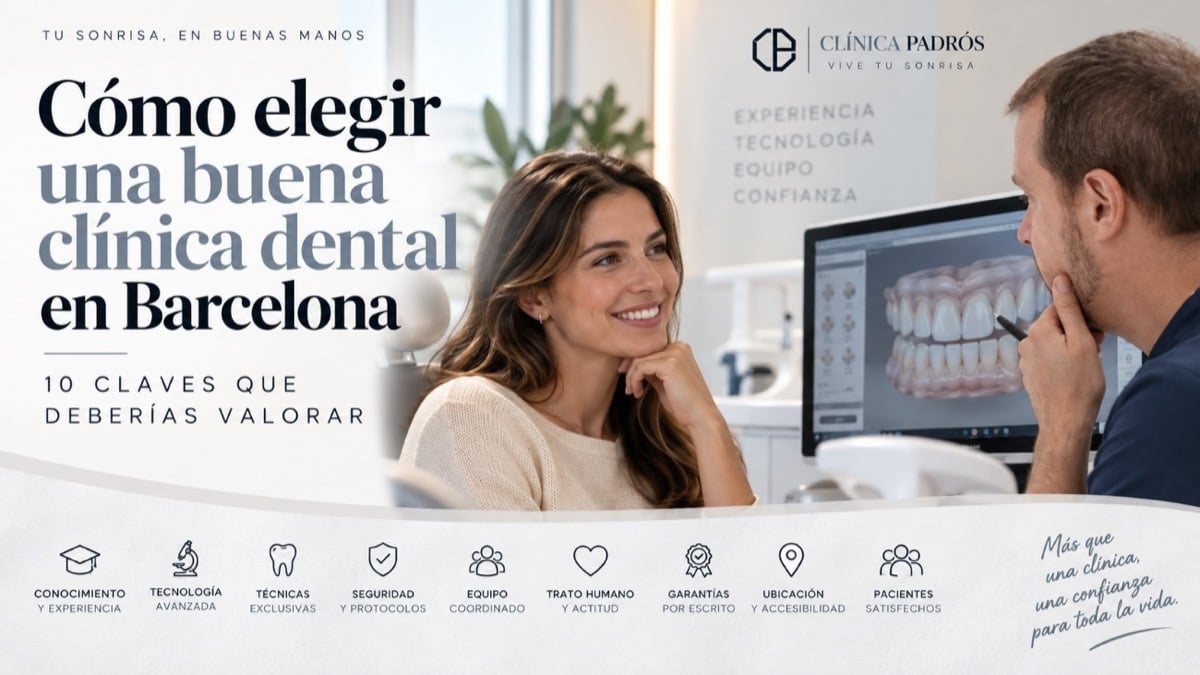
How to choose a good dental clinic in Barcelona: 10 keys
- greater experience and skill of the professionals
- three-dimensional planning
- a study of the quantity and quality of the bone
- guided surgery
- strict sterilisation protocols
- surgical instruments that are renewed frequently
- a team with many years of experience
- a good laboratory
- follow-up check-ups
- and a guarantee
1. Knowledge and experience of the team
This is probably the most important factor of all. Dentistry has evolved enormously. Today we have techniques, materials and technologies that did not even exist twenty years ago. But no technology replaces the knowledge of the professional who uses it. Before choosing a clinic, it is worth asking yourself:- What training do the dentists have?
- Are they specialists?
- Do they keep up with continuing education?
- Do they teach?
- Do they take part in courses or congresses?
- Do they publish scientific or teaching work?
- How much experience do they have?
- Who will plan my case?
The case of Clínica Padrós
Clínica Padrós was founded more than six decades ago. Its current director has more than three decades of clinical experience, and the dental team is made up of professionals involved in university teaching, postgraduate courses and master's programmes. Over the years, team members have taken part in publishing more than 100 articles and two books, have directed postgraduate and master's programmes for more than 15 years, and have developed and refined their own clinical techniques. The clinic and its professionals have also received a number of awards and distinctions. But perhaps the most important thing is not the CV. It is that all this knowledge ends up reaching the patient.2. Technology: not to have more machines, but to diagnose and treat better
A modern clinic can have an enormous amount of technology. But having technology should not be a goal in itself. The important question is: does this technology help to diagnose better, treat more precisely or make treatment more comfortable and safer? For example, a conventional X-ray can provide a lot of information. But in certain situations a three-dimensional CBCT scan shows structures that we simply cannot assess in the same way in two dimensions. An intraoral scanner can avoid some conventional impressions and provide extremely accurate digital models. A microscope lets us work while seeing details that are very hard to appreciate with the naked eye.What technology can be useful in an advanced dental clinic?
Depending on the treatments, it may include:Diagnosis
- digital intraoral radiography
- panoramic X-ray
- cephalometric X-ray
- 3D CBCT
- intraoral cameras
- caries detection systems
- NIR/NIRI technology
- AI-assisted diagnostic systems
Digital dentistry
- intraoral scanners
- CAD-CAM
- CEREC chairside systems
- digital smile design
- simulation
- 3D printing
Magnification
- high-end loupes
- operating microscope
Surgery
- digital planning
- electronically controlled implant motors
- piezoelectric surgery
- systems to obtain and process platelet concentrates when indicated
Root canal treatment
- dedicated torque-controlled motors
- magnification
- advanced instrumentation
Prevention and maintenance
- Airflow systems
- digital periodontal diagnosis
- intraoral cameras
Aesthetics
- photographic studio
- design software
- mock-up systems
- professional whitening equipment
3. Which techniques the clinic really uses
Here there is a difference that patients often cannot see. Two dentists can use exactly the same material and get very different results. Why? Because the protocol matters as much as the material.An example: composite veneers
A composite veneer can be made:- with a simple technique
- by layering
- by injection
- using digital planning
- with a prior mock-up
- with different dentine and enamel shades
- using characterisations and optical effects
- with direct, semi-direct or indirect techniques, or with chairside CAD-CAM technology
Our own techniques and refined protocols
Over the years we have developed or refined a number of protocols. For example:- advanced composite layering techniques
- compacted and layered composite systems
- our own whitening protocols
- advanced sealing techniques in root canal treatment
- procedures to reduce sensitivity in prepared teeth
- digital planning and trial protocols
4. Does the clinic update its protocols?
Patients rarely ask this question. And yet it is extremely important. Dentistry changes constantly. New materials, new adhesive systems, new sterilisation protocols, new studies, new techniques and new digital technologies keep appearing. A clinic can buy a new machine. But truly updating a clinic means something much deeper: continuously reviewing how treatments are done. Our team regularly reviews protocols, materials, techniques and results. When an improvement brings real benefits to patients, we study it and, where appropriate, adopt it. We also hold weekly meetings to review protocols and coordinate treatments.5. Safety: the little things patients don't see
This is probably one of the most invisible differences between clinics. A patient can see the reception, the chair, the dentist and the result. But there are hundreds of clinical decisions they never see.How many times is an instrument reused?
Many instruments have a defined working life. With use they wear, lose cutting efficiency, suffer fatigue and become less precise. For some root canal instruments, for example, the recommendations may allow several uses. In our clinic we have chosen to work with particularly conservative internal limits, using certain instruments far fewer times than the maximum allowed or recommended by their protocols, and in some cases limiting them to a single use. We apply a similar approach to certain instruments and burs used in implant dentistry, restorative dentistry, surgery and other procedures. This increases material costs. But our priority is different: safety, precision and effectiveness.6. Sterilisation and instrument maintenance
Sterilisation should be taken for granted. But there are also differences in how it is organised. It is important to consider: cleaning, pouching, sterilisation and traceability protocols, maintenance of handpieces, checks on the equipment and renewal of instruments. At Clínica Padrós our sterilisation and maintenance systems are arranged so that the flow of instruments is fast, controlled and reproducible. We also carry out specific maintenance of rotary instruments. These are processes few people see. And the processes nobody sees are often among the most important.7. Experience, stability and coordination of the team
A dental clinic is not only the dentist. Many people are involved in making a complex treatment work: dentist, hygienist, dental nurse, reception, laboratory and specialists. When a team has worked together for a long time, something that money can't easily buy appears: coordination. Everyone knows the protocols, the way of working, the professional's preferences, the steps of the treatment, how to anticipate problems and how to look after the patient.Why does it matter that staff stay at a clinic for years?
Keeping a good team means hiring well, training, offering stability, creating a good atmosphere and paying fairly. Naturally, all this has a cost. But the alternative —teams that keep changing— also has consequences. At Clínica Padrós much of the team has worked together for many years. We also hold weekly team meetings, including sessions to review cases, coordinate treatments, discuss incidents, update protocols, practise procedures and introduce new techniques. When several specialties are involved in a patient's care, this coordination becomes even more important.8. Attitude is also part of quality
We could have the best implant and the best scanner in the world. But the patient will still remember something much simpler: how they were treated. A good experience starts before you enter the surgery. It includes listening, explaining, keeping to schedules, answering questions, anticipating needs, accompanying, calling when necessary, being careful, solving problems and showing empathy. This does not happen by itself. It also has to be trained. In our clinic we work hard on the team's proactive attitude. We want anyone who comes in to feel from day one that there is a real interest in helping them and that someone is looking after their treatment.9. Does the clinic offer written guarantees?
Dentistry works with biology. So no serious professional should promise that absolutely nothing can go wrong. But that is compatible with offering clear guarantees on certain treatments and materials. Before accepting a major treatment, it is worth asking: what guarantee does it have? What does it cover? What are the conditions? Is it in writing? What happens if a problem arises? At Clínica Padrós we offer three-year written guarantees on certain restorative, prosthetic and implant treatments, subject to their clinical and maintenance conditions. This brings transparency. And it also obliges the clinic to take responsibility for its work.10. Social proof: what do patients who have been going there for years say?
Reviews are useful. But there is an even more interesting kind of social proof: patients who keep coming back for years. A clinic can make a good first impression. Keeping people's trust for 10, 20 or 30 years is harder. Before choosing a clinic, it can help to look at reviews, testimonials, real cases, patient videos, how long the clinic has been open and other patients' experiences. Clínica Padrós has treated tens of thousands of patients throughout its history, many of whom still trust the team decades later. There are also public reviews, testimonials and video testimonials where you can learn about their experiences.11. Is the clinic easy to get to?
It may seem a secondary factor. It isn't. Many treatments require several appointments, check-ups, maintenance visits, emergencies and long-term follow-up. An excellent clinic in a place that is impossible to reach can make follow-up difficult. That is why it is worth considering public transport, parking, accessibility and opening hours. Clínica Padrós is close to several public transport links and also makes parking easier for its patients in several nearby car parks.Why are some dental clinics more expensive than others?
This brings us to one of the most interesting questions. Imagine two quotes: Clinic A — Implant: X € Clinic B — Implant: X + 30 % It is easy to conclude: “the second one is more expensive”. But we are still missing information. We need to know who will carry out the treatment, what training they have, which implant is used, how it is planned, whether there is a CBCT scan, whether digital planning is done, which instruments are used, how often they are renewed, how they are sterilised, which laboratory makes the prosthesis, what materials are used, how many check-ups are included, what guarantee exists and what happens if a problem arises. Only then can we compare.Is it worth paying a little more for a good dental clinic?
Sometimes it is. But I would change the question slightly. It is not “should I pay more?”. It is “what am I getting in return?”. Paying more does not automatically guarantee better dentistry. Just as paying less does not necessarily mean getting poor treatment. What we should weigh up is the balance between quality, safety, experience, technology, time and results. In medicine and dentistry there is also a particularly important factor: some decisions cannot be undone. We can return a car. We can change our phone. But tooth enamel that has been removed does not grow back. That is why choosing the professional who will carry out certain treatments deserves different thinking from buying an ordinary product.Cheap can turn out expensive… but expensive doesn't guarantee quality either
It is best to avoid oversimplifying. We would not choose a clinic just because it is the cheapest. But not because it is the most expensive either. We would choose the one that gives us the most confidence after looking at:- Training
- Experience
- Diagnosis
- Planning
- Technology
- Protocols
- Safety
- Team
- Results
- Follow-up
- Guarantees
12 questions I would ask before choosing a dentist
Before having a major treatment, I would ask:- Who will carry out my treatment?
- What experience do they have with this type of case?
- Are there more conservative alternatives?
- Which diagnostic tests do I need?
- Can I see similar cases you have treated?
- Which material or system will you use?
- Why have you chosen this technique?
- What are the risks?
- What maintenance will I need?
- What will happen if a complication arises?
- What guarantee does it have?
- How will this treatment look in 10 or 20 years?
Warning signs to think about before choosing a clinic
I would be careful with messages such as:- “This treatment is right for everyone.”
- “It can't fail.”
- “We guarantee you a perfect result.”
- “You need to decide today to keep this price.”
- “This treatment has no risks.”
What really defines a quality dental clinic?
After more than six decades in practice, our view is that quality does not depend on any single thing. It isn't the microscope. It isn't the scanner. It isn't the doctor. It isn't the material. It isn't the reception. It isn't the guarantee. It is the combination of all of them. We could sum it up with this formula: Knowledge + Technology + Protocols + Experience + Safety + Team + Attitude + Follow-up = Quality of care And there is one more element: consistency. Doing something extraordinarily well one day is relatively easy. The real challenge is trying to do it every day, with every patient, for decades.So, how do you choose a good dentist in Barcelona?
Don't necessarily look for the cheapest, the most expensive, the most famous dentist or the one with the most technology. Look for a team that can show training, experience, results, clear protocols, diagnostic ability, useful technology, follow-up, transparency and a clinical philosophy you feel comfortable with. And then do something surprisingly important: talk to them. Trust can also be felt. A good first visit should let you leave the clinic understanding what you have, what options exist, what we recommend, why we recommend it and what you can expect.Our way of understanding dentistry
At Clínica Padrós we have spent more than six decades trying to improve on the same idea: treating every patient as we would like someone in our own family to be treated. That requires investment. In training. In professionals. In technology. In materials. In time. In sterilisation. In maintenance. In protocols. And in things the patient will probably never see. But very often it is precisely those unseen things that end up determining the quality of a treatment.Frequently asked questions about choosing a dental clinic
How can you tell if a dentist is good?By looking at their training and experience, the technology they use, the protocols and techniques they apply, safety and sterilisation, the stability of their team, their attitude towards patients, whether they offer written guarantees and what long-standing patients say.
Is it better to choose the cheapest dental clinic?Not necessarily. Price alone does not determine the quality of a treatment; you also need to consider the diagnosis, technology, materials, the team's experience and the guarantees offered.
Why do two clinics charge different prices for the same treatment?Because even if the treatment has the same name, it may involve very different levels of diagnosis, planning, technology, materials, sterilisation, team experience and follow-up.
What guarantees should a dental clinic offer?Clear written guarantees on certain treatments and materials, stating what they cover, their conditions and what happens if a problem arises.
Does it matter that the clinic's team has worked together for many years?Yes. A stable team knows the protocols better, coordinates more effectively between specialties and can anticipate problems better during treatment.
Does a clinic need a lot of technology?Technology should not be a goal in itself. What matters is that it helps to diagnose better, treat more precisely or make treatment more comfortable and safer.
What matters more, the price or the dentist's experience?Experience and the quality of the diagnosis usually matter more than price, because much of the result and the long-term safety of the treatment depend on them.
What should I ask before accepting a major dental treatment?Who will carry it out, what experience they have with similar cases, whether there are more conservative alternatives, what the risks are, what maintenance you will need and what guarantee the clinic offers.